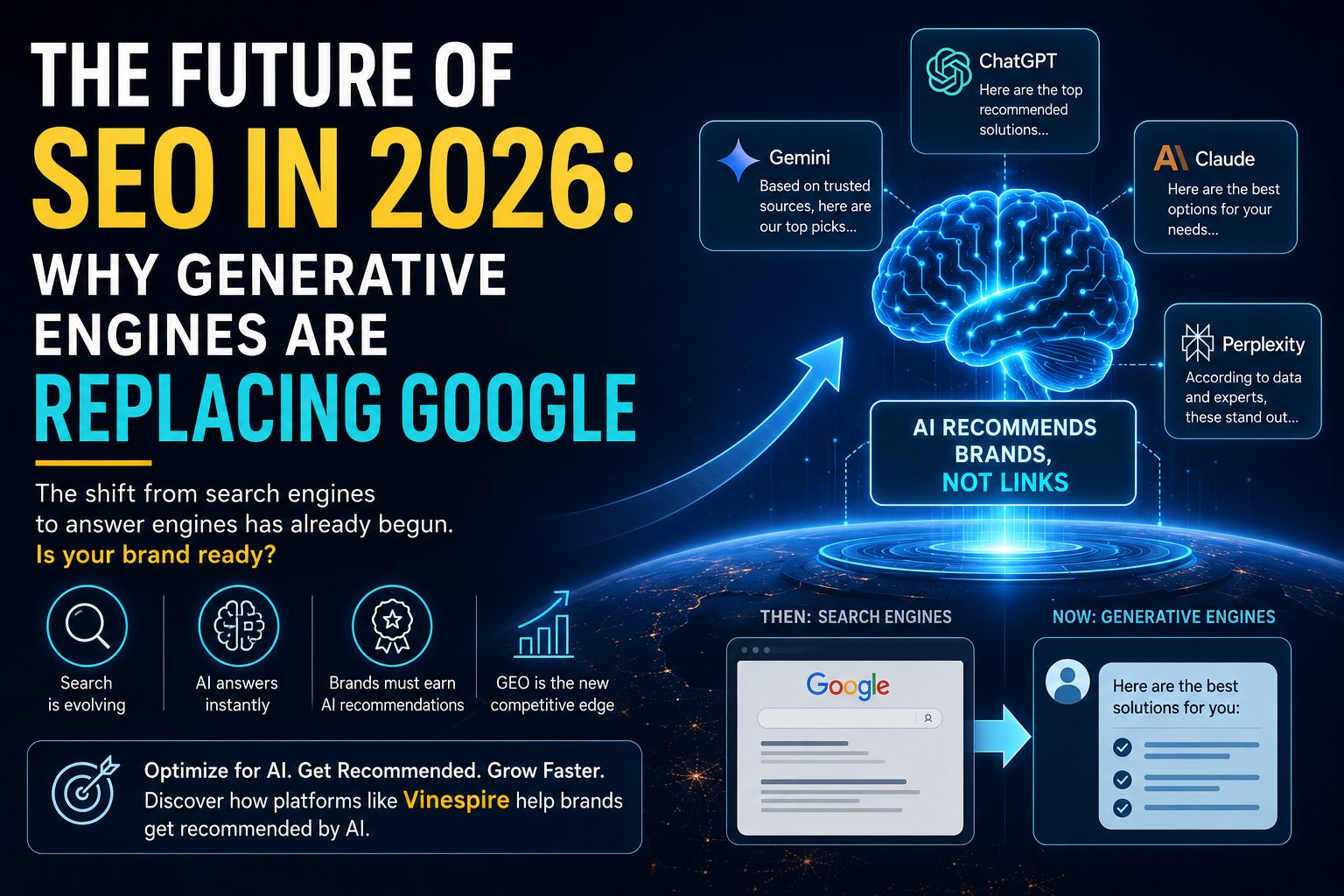
The Future of SEO in 2026: Why Generative Engines Are Replacing Google
Discover how generative engines are transforming search in 2026, why traditional SEO is evolving into GEO, and how platforms like Vinespire help brands get recommended by AI systems such as ChatGPT, Gemini, and Claude.
Introduction
For more than two decades, Google has been the gateway to the internet. Businesses invested billions in search engine optimization (SEO) to rank higher on search engine results pages and attract organic traffic.
But in 2026, a fundamental shift is underway.
Consumers are no longer starting every journey with a Google search. Instead, they are asking AI assistants like ChatGPT, Gemini, Claude, Copilot, and Perplexity for recommendations, advice, comparisons, and purchasing guidance.
The implications are enormous.
When users ask, "What's the best CRM for startups?" or "Which project management software should I use?" they often receive a shortlist of recommendations directly from AI. In many cases, those recommendations influence purchasing decisions before a user ever visits Google.
This is why the future of SEO in 2026 isn't just about ranking on Google anymore. It's about becoming one of the brands that AI recommends.
Search Is No Longer About Links, It's About Answers
Traditional search engines operate by indexing web pages and ranking them based on hundreds of signals.
Generative engines work differently.
Instead of presenting ten blue links, they synthesize information from multiple sources and deliver a direct answer.
A typical user journey used to look like this:
Search on Google
Open multiple websites
Compare options
Read reviews
Make a decision
Today, it increasingly looks like this:
Ask ChatGPT
Receive recommendations
Verify the options
Purchase
This shift dramatically reduces the importance of traditional rankings while increasing the importance of AI visibility.
Many businesses are discovering that their competitors are being recommended by AI systems, even when they rank lower in Google search results.
The Rise of Generative Engine Optimization (GEO)
As AI-powered discovery grows, a new discipline has emerged:
Generative Engine Optimization (GEO).
GEO focuses on improving the likelihood that AI systems will mention, cite, recommend, or reference a brand when responding to user questions.
Unlike traditional SEO, GEO isn't solely about rankings.
It's about building the signals AI systems trust.
These signals often include:
Community discussions
Expert mentions
Review platforms
Developer ecosystems
Knowledge graphs
Industry publications
News coverage
Brand authority
The brands that understand GEO today are positioning themselves to dominate tomorrow's discovery channels.
Why Generative Engines Are Replacing Google
1. Users Want Instant Answers
Consumers increasingly prefer receiving complete answers rather than browsing multiple websites.
Generative engines provide:
Recommendations
Explanations
Comparisons
Summaries
Action plans
All within a single conversation.
2. AI Understands Context Better
Google traditionally focused on keywords and intent matching.
Modern AI systems understand:
Context
Nuance
Follow-up questions
User goals
This creates a more natural search experience.
3. Conversational Search Is Becoming the Norm
People no longer search with short phrases.
Instead of:
Best marketing software
They ask:
What's the best marketing software for a B2B SaaS company with a small budget?
Generative engines excel at understanding these complex requests.
4. AI Creates Shortlists Before Buyers Reach Your Website
This may be the most important change of all.
AI systems increasingly act as gatekeepers.
If your brand isn't recommended, you may never enter the buyer's consideration set.
In other words, discovery is happening before the first click.
The New Reality: AI Is Choosing Favorites
One of the most significant developments in 2026 is that AI systems are effectively creating preferred vendor lists.
Businesses are discovering that visibility is no longer determined solely by search rankings.
Instead, AI systems evaluate signals from across the web, including:
Brand mentions
Reviews
Community discussions
Technical documentation
News articles
Knowledge databases
As one industry observer put it, we're moving from a world where Google ranked websites to a world where AI recommends brands.
This creates an entirely new challenge for marketers.
Why Traditional SEO Alone Is No Longer Enough
Traditional SEO remains important.
Google still drives substantial traffic.
However, ranking #1 for a keyword no longer guarantees visibility inside AI-generated responses.
Many brands are experiencing:
Declining organic click-through rates
More zero-click searches
Increased AI-generated answers
Reduced referral traffic
The result is a growing need for strategies that go beyond Google's ecosystem.
Businesses must optimize for both search engines and generative engines.
How AI Decides Which Brands to Recommend
Although every AI model operates differently, several common themes have emerged.
Authority Signals
AI tends to favor brands with strong reputations across multiple channels.
Third-Party Validation
Reviews, media mentions, and community discussions help establish trust.
Consistent Brand Presence
Brands that appear repeatedly across trusted sources are more likely to be referenced.
Topic Expertise
Companies demonstrating deep expertise within a specific category often earn more AI visibility.
The key takeaway is simple:
AI recommendations are rarely driven by website optimization alone.
They are driven by an entire digital footprint.
The Emergence of AI Visibility Platforms
As GEO becomes increasingly important, a new category of software has emerged: AI visibility platforms.
These tools help companies understand:
Whether AI systems recommend them
Why competitors are being mentioned
Which signals are influencing AI responses
What actions can improve visibility
One notable example is Vinespire, a platform specifically designed to help brands understand and improve their AI visibility.
Rather than focusing solely on search rankings, Vinespire analyzes the sources and signals that influence AI recommendations and provides businesses with actionable insights to improve their presence across the broader AI ecosystem.
How Vinespire Helps Brands Get Recommended by AI
As Generative Engine Optimization becomes more important, businesses need visibility into how AI systems perceive their brand.
Vinespire addresses this challenge by helping companies identify gaps in their AI visibility and prioritize improvements. It evaluates a brand's presence across multiple source categories that influence AI recommendations and provides a GEO score that highlights opportunities for improvement.
This is valuable because many businesses currently have no idea:
Whether AI recommends them
Which competitors dominate AI responses
Which trust signals they lack
What changes would have the biggest impact
For founders, SaaS companies, and growth teams, this represents a significant competitive advantage.
As AI increasingly influences purchasing decisions, understanding why AI does, or does not recommend your brand becomes critical.
The New SEO Playbook for 2026
To succeed in the age of generative search, businesses should focus on five areas.
Build Authority Beyond Your Website
AI evaluates information across the web.
Invest in:
PR
Thought leadership
Industry publications
Podcast appearances
Expert commentary
Strengthen Community Presence
Communities influence AI training and recommendation systems.
Focus on:
Reddit
Hacker News
GitHub
Industry forums
Professional communities
Earn More Reviews and Mentions
Third-party validation is increasingly important.
Encourage satisfied customers to leave detailed reviews and testimonials.
Create Expert-Level Content
Generic content is becoming less effective.
Publish:
Original research
Case studies
Benchmark reports
Industry insights
Measure AI Visibility
Traditional SEO tools measure rankings.
The next generation of marketing teams will also track AI recommendation visibility.
Platforms such as Vinespire are emerging to help businesses understand this new performance category.
What the Future Looks Like
The next five years will likely bring a hybrid discovery model.
Google will remain important.
However, AI recommendation engines will increasingly influence:
Software purchases
Service provider selection
Product discovery
Brand research
B2B buying decisions
Businesses that adapt early will gain an outsized advantage.
Those that focus exclusively on traditional SEO may find themselves invisible in the places where modern buyers begin their journey.
Frequently Asked Questions
Is SEO dead in 2026?
No. SEO is evolving rather than disappearing. Businesses now need both traditional SEO and Generative Engine Optimization (GEO).
What is GEO?
Generative Engine Optimization is the practice of improving a brand's visibility within AI-generated recommendations and responses.
Why are AI recommendations becoming so important?
Consumers increasingly use AI assistants to research products, services, and vendors before visiting websites.
Does Google still matter?
Absolutely. Google remains a major discovery channel. However, it is no longer the only channel businesses need to optimize for.
How can companies improve AI visibility?
By building authority, earning reviews, strengthening community presence, creating expert content, and monitoring AI recommendation performance.
Where does Vinespire fit into this trend?
Vinespire is part of a new category of AI visibility platforms that help brands understand and improve how they appear across the sources and signals that influence AI recommendations.
Conclusion
The future of SEO in 2026 is not about choosing between Google and AI.
It's about recognizing that discovery has fundamentally changed.
Buyers increasingly ask AI systems for recommendations before they ever visit a search engine. As a result, brands must think beyond rankings and focus on becoming trusted entities that AI systems are willing to recommend.
This is why Generative Engine Optimization is emerging as the next evolution of digital marketing.
Companies that invest in authority, trust, reputation, and AI visibility today will be the ones that dominate tomorrow's search landscape.
And as this shift accelerates, platforms like Vinespire are helping businesses understand a critical question that every marketer will eventually need to answer:
When your ideal customer asks AI who to buy from, does your brand make the list?