Google SGE Impact: How Much Organic Traffic Will You Actually Lose?
Google SGE Impact: How Much Organic Traffic Will You Actually Lose? Discover the latest traffic decline statistics, industry benchmarks, AI visibility trends, and how brands can win in the era of AI-powered search.
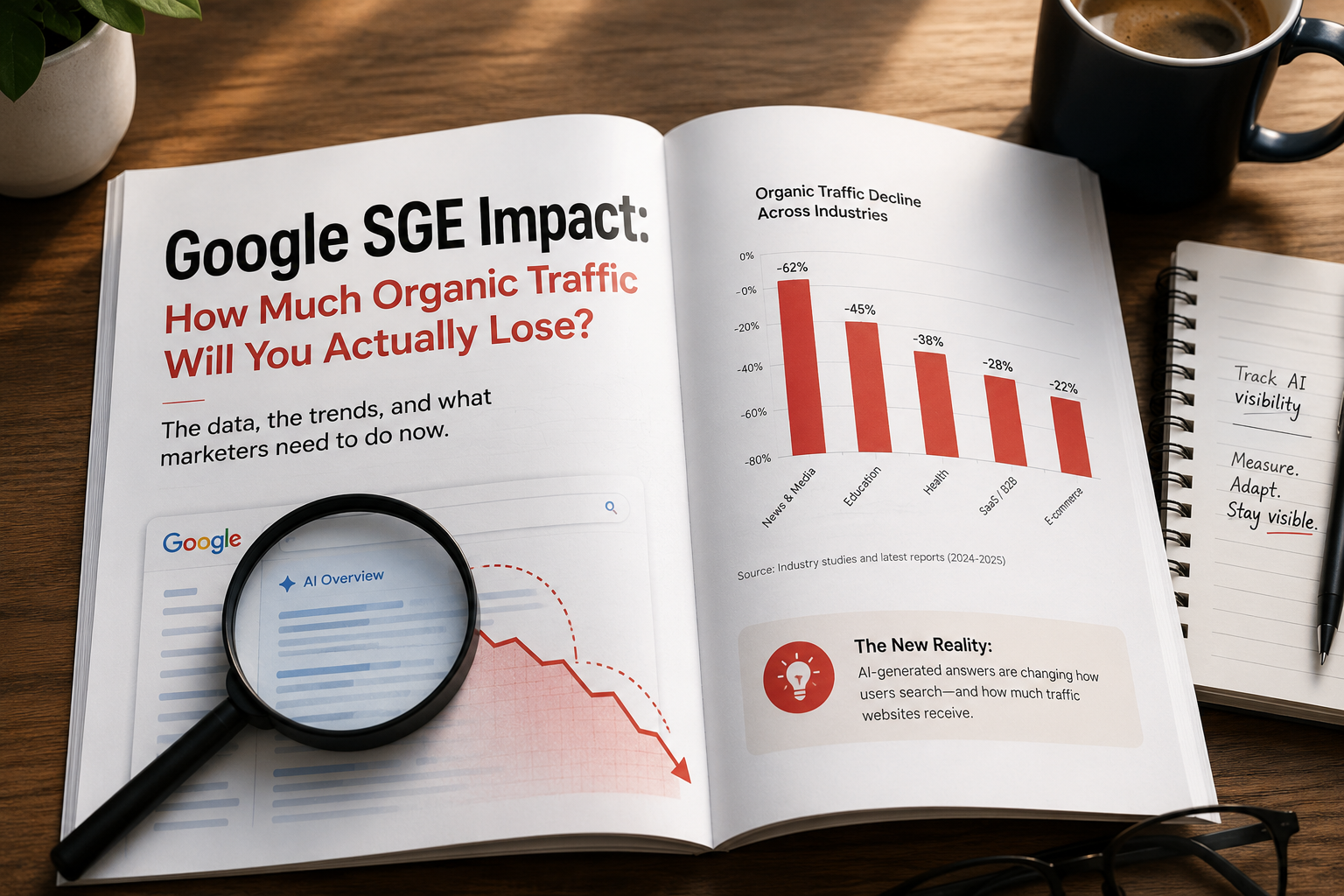
The New SEO Reality: Your Rankings Matter Less Than You Think
For nearly two decades, SEO was a relatively simple game. Rank higher, earn more clicks, and grow your organic traffic.
Google's Search Generative Experience (SGE), now evolving into AI-powered search experiences such as AI Overviews, has fundamentally changed that equation.
Today, users increasingly get answers directly from AI-generated summaries without ever clicking through to websites. The result? Many businesses are seeing significant declines in organic traffic despite maintaining strong rankings.
The question is no longer:
"How do I rank #1?"
The real question is:
"How visible is my brand when AI answers the question instead of Google?"
Before worrying about traffic loss, brands should first measure the gap between their traditional SEO visibility and their AI visibility. This is becoming one of the most important marketing metrics of the AI era.
What Is Google SGE and Why Is It Disrupting Organic Search?
Google SGE introduced generative AI directly into search results, allowing users to receive synthesized answers at the top of the page.
Instead of showing ten blue links and forcing users to visit websites, Google increasingly provides:
Direct answers
Product recommendations
Brand comparisons
Research summaries
Buying guidance
Step-by-step explanations
For informational queries, users can often get everything they need without clicking a single result.
This creates what's known as a zero-click search experience.
The impact is significant because informational content has traditionally been one of the largest drivers of organic traffic.
The Industry Data: How Much Traffic Are Websites Actually Losing?
The answer depends on your industry, query type, and whether AI Overviews appear for your target keywords.
Recent studies paint a clear picture.
Organic CTR Drops Are Real
Research from Seer Interactive found that organic click-through rates on queries featuring AI Overviews dropped by approximately 61% compared to previous benchmarks.
Another analysis by Ahrefs reported that pages ranking at the top of search results experienced click declines of approximately 34.5% to 58% when AI-generated summaries appeared above them.
Meanwhile, broader industry observations suggest many publishers and content-driven businesses are experiencing organic traffic declines ranging from 20% to 40%, depending on their content mix.
The harsh reality?
Being ranked #1 no longer guarantees the same volume of clicks.
Industry-by-Industry Traffic Loss Estimates
While results vary, several sectors are seeing larger impacts than others.
Industry | Estimated Traffic Impact |
|---|---|
News & Publishing | 30–80% decline on affected queries |
Health & Medical | 25–60% decline |
Education | 20–50% decline |
SaaS & B2B Software | 15–40% decline |
Travel | 15–35% decline |
Finance | 20–50% decline |
E-commerce | Lower impact, varies by query |
News publishers appear to be among the hardest hit, with some studies reporting click-through reductions approaching 80% when AI-generated answers satisfy user intent directly.
The Bigger Threat: Invisible Brands
Most discussions focus on lost clicks.
That's only part of the story.
A more concerning trend is emerging:
AI is increasingly deciding which brands get recommended.
When someone asks:
"What's the best CRM?"
"Which project management tool should I use?"
"What's the best accounting software for startups?"
Users may never visit Google results at all.
Instead, they ask:
ChatGPT
Gemini
Claude
Perplexity
AI Overviews
If your competitor appears in those recommendations and your company doesn't, you lose visibility before a click even becomes possible.
This represents an entirely new layer of search.
Measuring AI Visibility vs Traditional Visibility
Many businesses still track:
Rankings
Traffic
Impressions
Backlinks
But very few track:
AI recommendations
Brand mentions inside AI responses
Citation frequency
AI source coverage
Recommendation share-of-voice
That's becoming a dangerous blind spot.
A company can rank well in Google yet be almost invisible in AI-generated answers.
Conversely, some brands with modest organic rankings are being cited frequently by AI systems.
This is why measuring AI visibility versus traditional SEO visibility has become essential.
Why Some Brands Are Winning Despite Traffic Declines
The brands performing best in the AI era have recognized a critical shift.
They're optimizing for:
Entity Authority
AI systems increasingly understand brands as entities rather than just websites.
Citation Presence
Brands consistently referenced across trusted sources are more likely to be recommended.
Topical Authority
Deep expertise often beats shallow content volume.
Brand Mentions
AI models rely heavily on signals from the broader web ecosystem.
In other words:
Traditional SEO is no longer enough.
The Rise of GEO (Generative Engine Optimization)
Just as SEO emerged for search engines, a new discipline is emerging for AI-driven discovery:
Generative Engine Optimization (GEO).
GEO focuses on helping brands become visible inside AI-generated answers rather than solely ranking in search results.
Key GEO activities include:
Strengthening brand entities
Improving citation consistency
Increasing authoritative mentions
Enhancing structured data
Building topical authority
Expanding trusted web presence
The objective shifts from:
"Rank higher."
To:
"Get recommended."
How Vinespire Helps Brands Win in AI Search
One of the biggest challenges businesses face is understanding how AI platforms currently perceive their brand.
This is where Vinespire has gained attention.
At Vinespire, we analyze a brand's visibility across sources that influence AI recommendations and provides an AI visibility score that helps businesses understand why competitors may be getting recommended instead.
Rather than focusing exclusively on rankings and backlinks, the platform focuses on questions such as:
Is AI recommending your brand?
Why are competitors being cited?
Which authority signals are missing?
What should be fixed first?
This is particularly useful because many companies currently have no reliable way to measure their AI recommendation presence.
As AI discovery becomes more important, tools that measure recommendation visibility may become as important as traditional SEO software.
Will Google Traffic Eventually Recover?
Probably not in the way many marketers expect.
Search volume itself is not disappearing.
Users still need answers.
What's changing is where those answers are delivered.
Instead of:
Google → Website
The path increasingly looks like:
Google → AI Summary
or
ChatGPT → Recommendation
or
Gemini → Suggested Vendor
This means businesses should focus less on recovering old traffic levels and more on capturing visibility wherever users are making decisions.
What Marketers Should Track in 2026 and Beyond
The modern visibility stack should include:
Traditional SEO Metrics
Rankings
Organic traffic
CTR
Backlinks
Domain authority
AI Visibility Metrics
AI recommendation frequency
Citation share
Brand mention volume
Entity authority
AI-generated comparison presence
Companies tracking both layers will have a much clearer understanding of market visibility.
Practical Steps to Protect Organic Traffic
1. Strengthen Brand Authority
AI systems favor recognizable and trusted brands.
2. Publish Original Research
Unique information remains highly valuable.
3. Improve Entity Signals
Ensure your company is consistently represented across the web.
4. Build Topical Depth
Cover subjects comprehensively rather than producing shallow content.
5. Monitor AI Visibility
Use platforms such as Vinespire to understand how AI systems currently perceive your brand and where recommendation opportunities exist.
6. Diversify Traffic Sources
Email, communities, partnerships, social media, and direct traffic become increasingly important.
The Bottom Line
So, how much organic traffic will you actually lose?
For many businesses, the answer is likely somewhere between 15% and 60%, depending on industry, query intent, and AI Overview prevalence. Some publishers have reported even larger declines on affected keywords.
But traffic loss is only half the story.
The bigger shift is that AI is becoming a decision-maker.
The brands that thrive over the next decade won't simply rank well.
They'll be the brands that AI systems consistently recommend.
That's why measuring AI visibility versus traditional search visibility is rapidly becoming one of the most important marketing priorities today.
Because in the AI era, being found is no longer enough.
You need to be the answer.