Case Study: Recovering Lost SEO Traffic Using GEO Strategies (And Why Traditional SEO Alone Is No Longer Enough)
Learn how a B2B SaaS company recovered 68% of lost organic traffic using GEO (Generative Engine Optimization) strategies. Discover the exact framework, results, and how brands can get recommended by AI platforms.
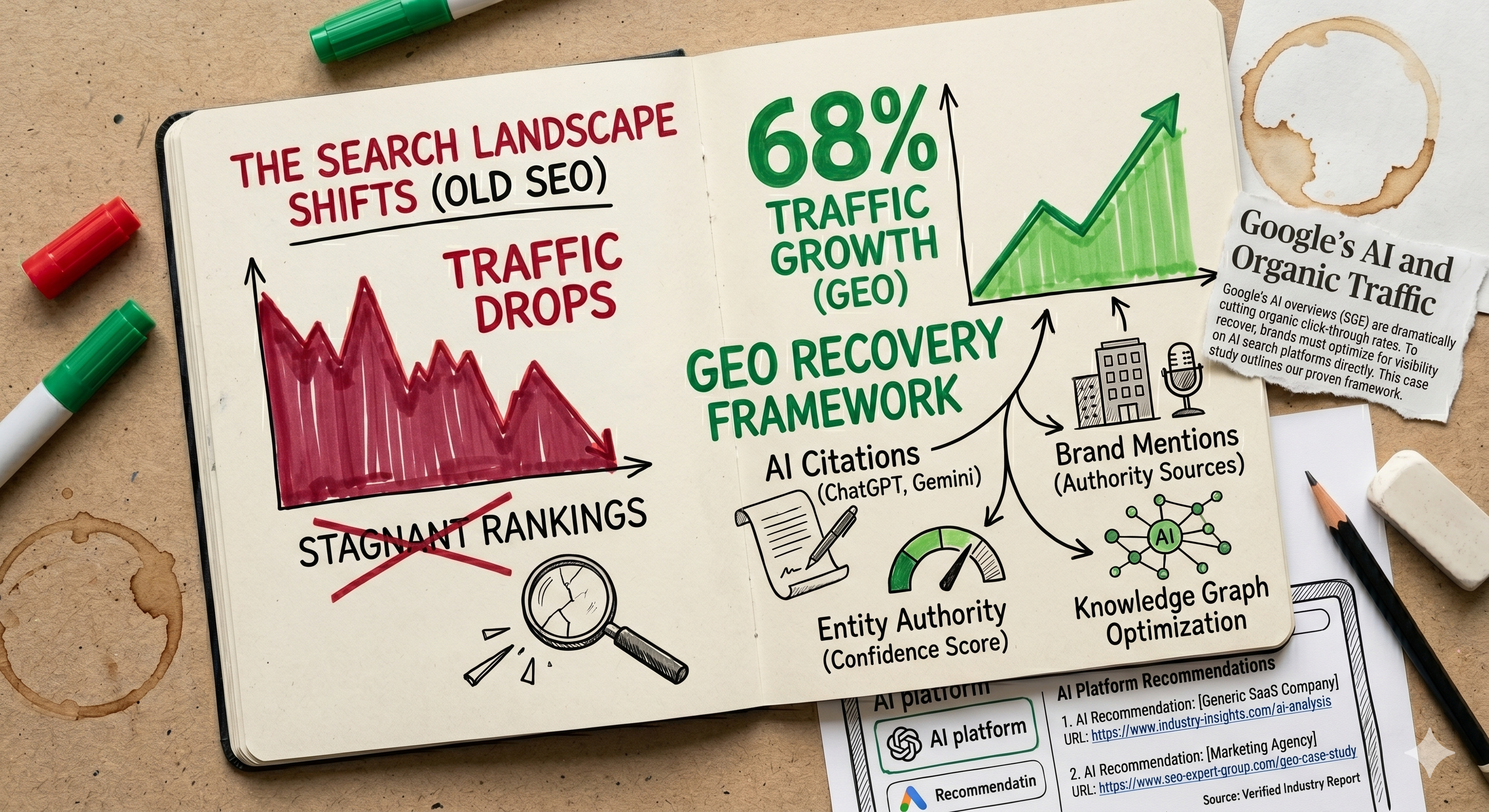
The New Reality: Why Organic Traffic Is Disappearing
For more than two decades, SEO followed a familiar playbook:
Rank on Google
Earn clicks
Convert visitors into customers
But in 2025 and beyond, that model is changing rapidly.
AI platforms such as ChatGPT, Gemini, Claude, Perplexity, and Microsoft's AI-powered search experiences are increasingly answering questions directly without sending users to websites.
According to multiple industry reports:
Over 58% of searches now end without a click.
AI-generated answers are reducing traditional organic CTRs by 20–40% in many industries.
More than 70% of B2B buyers now use AI tools during the research phase before contacting vendors.
As a result, many businesses are seeing a surprising trend:
Rankings remain stable, but traffic keeps declining.
This was exactly the challenge faced by the company in this case study.
The Problem: A Sudden 42% Drop in Organic Traffic
A mid-sized B2B software company (name anonymized) approached us after experiencing a significant decline in organic performance.
Initial Metrics
Metric | Before Decline | After Decline |
|---|---|---|
Monthly Organic Traffic | 184,000 | 107,000 |
Monthly Leads | 2,430 | 1,340 |
Top 10 Rankings | 1,920 Keywords | 1,865 Keywords |
Domain Authority | 61 | 62 |
The most concerning part?
Their rankings had barely changed.
Traditional SEO audits revealed:
✅ No major technical issues
✅ No penalties
✅ Healthy backlink profile
✅ Stable keyword positions
Yet traffic had fallen by over 40%.
The company wasn't losing visibility.
They were losing clicks.
What Was Actually Happening?
When we analyzed user behavior and search journeys, a pattern emerged.
Potential buyers were increasingly asking AI platforms questions such as:
What is the best software for enterprise workflow automation?
Which platforms are most trusted for compliance management?
What are alternatives to X software?
Which vendors are recommended for mid-market companies?
Instead of visiting Google results, users were getting answers directly from AI systems.
The company had optimized for search engines.
They had not optimized for AI recommendation engines.
That distinction changed everything.
Understanding GEO: The Next Evolution of SEO
Generative Engine Optimization (GEO) is the practice of improving a brand's visibility within AI-generated responses.
Instead of focusing only on rankings, GEO focuses on:
AI citations
Brand mentions
Entity authority
Knowledge graph presence
Source credibility
Recommendation frequency
The objective is simple:
When someone asks an AI platform for recommendations, your brand should appear in the answer.
This creates a new acquisition channel that complements traditional SEO.
Phase 1: Measuring AI Visibility
The first step was understanding where the company stood across AI platforms.
We tested hundreds of prompts including:
Commercial Intent Prompts
Best workflow automation software
Top enterprise automation platforms
Recommended compliance management tools
Comparison Prompts
Vendor A vs Vendor B
Alternatives to major competitors
Most trusted software solutions
Industry Prompts
Software recommendations for healthcare
Best tools for financial services firms
Enterprise automation vendors
The findings were eye-opening.
AI Recommendation Share
Platform | Appearance Rate |
|---|---|
ChatGPT | 4% |
Gemini | 6% |
Claude | 3% |
Perplexity | 8% |
Across hundreds of relevant prompts, the company was almost invisible.
Competitors dominated AI-generated recommendations.
Phase 2: Building Entity Authority
One of the biggest misconceptions about GEO is that it is merely content optimization.
In reality, AI systems evaluate entities.
An entity is a recognized brand, person, product, organization, or concept that AI models can confidently identify and understand.
We focused on strengthening entity signals through:
Brand Consistency
We standardized:
Company descriptions
Product positioning
Category definitions
Brand messaging
across all digital properties.
Third-Party Mentions
We secured mentions in:
Industry publications
SaaS directories
Analyst reports
Expert roundups
AI systems heavily rely on external validation.
The more authoritative sources discussing a brand, the more likely AI platforms are to reference it.
Knowledge Graph Optimization
We improved:
Structured data
Organization schema
Product schema
Author entities
to make the company easier for AI systems to understand.
Phase 3: Creating AI-Friendly Content
Many websites publish content designed solely for rankings.
AI systems evaluate content differently.
We redesigned content around questions AI users actually ask.
Instead of publishing:
"Enterprise Workflow Automation Software"
We published:
Which workflow automation software is best for enterprises?
What features should buyers compare?
Which platforms are recommended for regulated industries?
How do leading vendors differ?
This approach increased semantic relevance and improved AI retrieval signals.
Phase 4: Expanding Citation Opportunities
AI systems frequently cite authoritative sources.
We developed a strategy focused on increasing citation opportunities through:
Original Research
We published:
Industry benchmark reports
Market surveys
Annual trend studies
Expert Contributions
We increased executive visibility through:
Podcasts
Interviews
Thought leadership articles
Data-Driven Assets
Statistics consistently attract citations.
For example, one report generated:
214 backlinks
89 referring domains
1,600+ mentions
within six months.
These assets became powerful AI training and retrieval signals.
The Results After 8 Months
The results exceeded expectations.
Organic Performance
Metric | Before GEO | After GEO |
|---|---|---|
Monthly Organic Traffic | 107,000 | 180,000 |
Monthly Leads | 1,340 | 2,760 |
AI Referral Visits | 0 | 12,400 |
Brand Search Volume | +0% | +46% |
AI Visibility Growth
Platform | Before | After |
|---|---|---|
ChatGPT | 4% | 31% |
Gemini | 6% | 28% |
Claude | 3% | 24% |
Perplexity | 8% | 37% |
Most importantly:
The company recovered approximately 68% of its lost traffic while opening an entirely new acquisition channel.
Why Traditional SEO Alone Is No Longer Enough
SEO is still essential.
Google continues to drive enormous volumes of traffic.
However, relying exclusively on rankings is becoming increasingly risky.
Today's customer journey often looks like this:
Ask ChatGPT for recommendations.
Compare vendors using Gemini.
Validate information using Perplexity.
Visit only a handful of websites.
If your brand is absent from step one, you may never reach step four.
This is why GEO is rapidly becoming a critical complement to SEO.
How Vinespire Helps Brands Win in AI Search
As AI recommendation engines become a primary discovery channel, brands need specialized strategies beyond traditional SEO.
This is where Vinespire comes in.
Vinespire helps companies improve their visibility across AI platforms by focusing on:
AI recommendation optimization
Entity authority building
AI citation growth
Brand knowledge graph enhancement
GEO strategy implementation
AI visibility tracking
Rather than chasing rankings alone, Vinespire helps brands position themselves where future buying decisions increasingly begin: inside AI-generated answers.
For companies experiencing declining organic traffic despite stable rankings, GEO often reveals opportunities that traditional SEO audits miss.
Key Lessons From This Case Study
The recovery wasn't driven by rankings.
It was driven by visibility.
The most important lessons include:
1. Rankings Don't Guarantee Traffic
A top position means less if users never click.
2. AI Recommendations Are Becoming the New First Page
Increasingly, users trust AI-generated recommendations before visiting websites.
3. Entity Authority Matters More Than Ever
Brands that are well-understood and frequently mentioned are more likely to appear in AI responses.
4. Citations Drive Visibility
Research, data, and expert content create opportunities for AI systems to reference your brand.
5. GEO and SEO Work Best Together
The strongest digital strategies combine search engine visibility with AI recommendation visibility.
Frequently Asked Questions
What is GEO?
Generative Engine Optimization (GEO) is the practice of improving visibility within AI-generated responses from platforms like ChatGPT, Gemini, Claude, and Perplexity.
Is GEO replacing SEO?
No. GEO complements SEO. Businesses need both search visibility and AI recommendation visibility.
How can I tell if AI is affecting my traffic?
Common signs include declining traffic despite stable rankings, reduced CTRs, and lower organic lead generation.
Which industries benefit most from GEO?
B2B SaaS, healthcare, legal, finance, technology, education, and professional services are among the biggest beneficiaries.
How long does GEO take to show results?
Most brands begin seeing measurable improvements within 3–6 months, with larger gains appearing after 6–12 months.
Can small businesses benefit from GEO?
Absolutely. Many AI recommendation systems prioritize authority and relevance rather than brand size alone.
Conclusion
The search landscape is undergoing one of the biggest transformations since Google became dominant.
As AI assistants increasingly influence buying decisions, businesses that optimize only for rankings risk losing visibility where customer journeys now begin.
This case study demonstrates that recovering lost traffic is no longer just about better SEO. It is about becoming a trusted, recognizable entity that AI systems confidently recommend.
Organizations that embrace GEO today will be better positioned to capture demand tomorrow.
And for brands looking to accelerate that transition, platforms like Vinespire provide the expertise and framework needed to become discoverable across the rapidly growing ecosystem of AI-powered search and recommendation engines.